


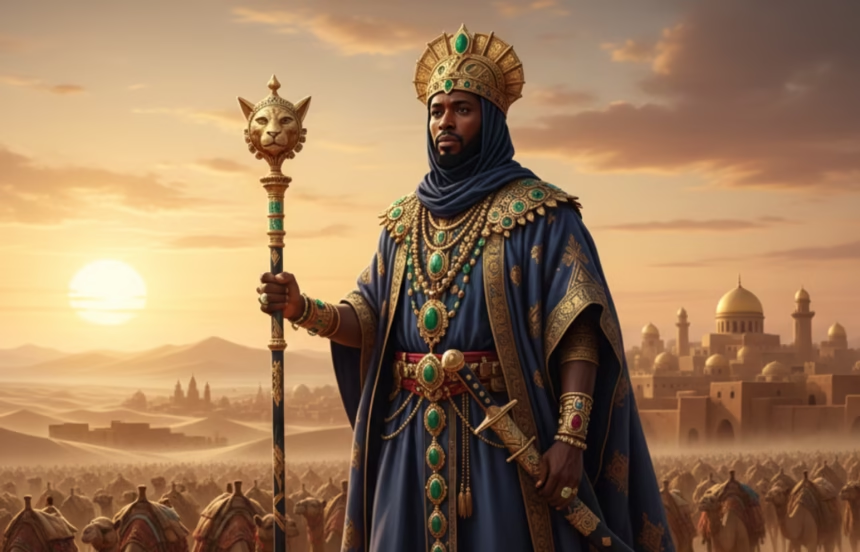
Riyadh : Mansa Musa, the 14th-century ruler of the Mali Empire, is widely regarded as the richest individual to have ever lived.
According to estimates cited by The Times of India (TOI), his wealth has been valued at around $131 billion (£99 billion) in modern terms, surpassing the fortunes of today’s richest billionaires.
The Other historical assessments place his riches even higher, ranging between $400 billion and $500 billion.
Born in 1280 into a royal family, Mansa Musa rose to power after his brother, Mansa Abu-Bakr, disappeared during a mysterious Atlantic expedition around 1312.
As reported in TOI, Abu-Bakr reportedly set sail with 2,000 ships, carrying thousands of people, and was never seen again.
While some historians have speculated that the expedition may have reached South America, there is no conclusive evidence to support the claim.
Following his brother’s disappearance, Mansa Musa inherited the throne and rapidly expanded the Mali Empire.
The empire stretched over 2,000 miles and included 24 major cities, among them Timbuktu. Its territory covered parts of present day Senegal, Mauritania, Mali, Burkina Faso, Niger, The Gambia, Guinea-Bissau, Guinea, and Ivory Coast.
Golden Empire
Under Mansa Musa’s rule, Mali controlled vast reserves of gold and salt, two of the most valuable commodities of the medieval world.
TOI reports that the empire produced nearly half of all the gold in the Old World, while thriving trans-Saharan trade routes further boosted its wealth.
Cairo Pilgrimage
In 1324, Mansa Musa undertook his famous pilgrimage to Mecca, travelling through Cairo with an enormous caravan.
As reported in TOI, his entourage included tens of thousands of people and hundreds of camels loaded with gold.
Also Read | Iraqi PM urges Muslim nations to unite in collective shield against Israel
His generosity was so extensive that gold prices collapsed, triggering a regional economic downturn that lasted nearly ten years.
US-based studies quoted in TOI estimate losses of about $1.5 billion (£1.1 billion) due to gold devaluation.
Some historical accounts suggest Mansa Musa later borrowed gold at high interest in an attempt to stabilise the economy.
Lucy Duran of the School of African and Oriental Studies in London, quoted by TOI, noted that Mali’s own griots traditional oral historians later criticised him for damaging the empire’s economic standing.
Timbuktu
Beyond wealth, Mansa Musa invested heavily in education, architecture, and culture.
TOI reports that he once rewarded a poet with 200 kilograms of gold, worth about $8.2 million today.
He built mosques, libraries, and schools, transforming Timbuktu into one of the world’s most important centres of learning.
He brought scholars from across the Islamic world, including Mecca, Medina, and Andalusia. Among them was the Andalusian architect Abu Es Haq es Saheli, who designed the iconic Djinguereber Mosque, still standing today.
Legacy and Decline
Mansa Musa died in 1337 at the age of 57. According to TOI, his successors failed to maintain unity, leading to the gradual fragmentation of the empire.
European expansion into West Africa later accelerated its decline.
Mansa Musa’s legacy endured. A 1375 Catalan Atlas famously depicts an African king believed to be Mansa Musa seated on a golden throne in Timbuktu, holding a piece of gold, symbolising a ruler whose wealth and influence left a lasting mark on world history.
