


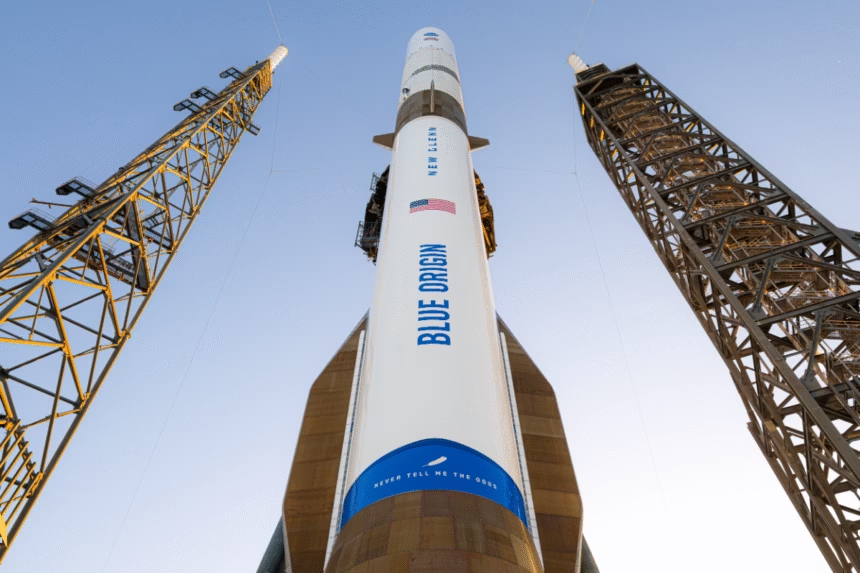
Washington – Blue Origin is preparing for the highly anticipated second launch of its New Glenn rocket this Sunday, marking a critical milestone in the company’s growing rivalry with Elon Musk’s SpaceX.
The towering 98-meter-tall rocket will carry NASA’s ESCAPADE twin spacecraft to Mars on a mission to study the planet’s climate history and atmospheric evolution part of ongoing efforts to lay the groundwork for future human exploration.
Beyond the scientific mission, the launch holds major technical significance. Blue Origin aims to successfully recover the rocket’s first-stage booster, a feat that could elevate its position in the reusable rocket market.
The company’s inaugural flight in January achieved orbital success, but the booster failed to land on its Atlantic recovery platform a challenge SpaceX has already mastered through years of refinement.
The launch window opens at 2:45 PM ET (1945 GMT) and will last 88 minutes. However, experts warn that any weather or technical delays could complicate rescheduling, especially as the Federal Aviation Administration (FAA) plans to restrict commercial rocket launches starting Monday due to airspace congestion during the U.S. government shutdown.
The mission is seen as a key test for Jeff Bezos’s aerospace company amid the intensifying commercial space race. With NASA soliciting bids for upcoming lunar projects, competition between Blue Origin and SpaceX has grown increasingly fierce each vying for leadership in reusable spaceflight and interplanetary missions.
Senior aerospace executive George Nield, who previously flew with Blue Origin, told Agence France-Presse (AFP) that Sunday’s mission carries immense weight for the company’s credibility. “How the launch plays out will be an indicator of how well they’re doing and how much progress they’ve made,” he said.
If successful, the ESCAPADE satellites are expected to reach Martian orbit by 2027, contributing valuable data on the planet’s magnetosphere and atmospheric loss.
Also Read | Elon Musk launches ‘Grokipedia,’ an AI-Powered rival to Wikipedia
Experts view Blue Origin’s persistence as a positive force in the evolving space industry. Mason Peck, a former NASA chief technologist, said increased competition fuels innovation: “More launches means more ideas in space. It can’t be a bad thing to have Blue Origin even trailing behind.”
The New Glenn mission represents not only a critical opportunity for Blue Origin to prove its technical capabilities but also a defining moment in the broader battle for commercial space dominance as billionaire-led ventures push humanity’s reach deeper into the cosmos.